
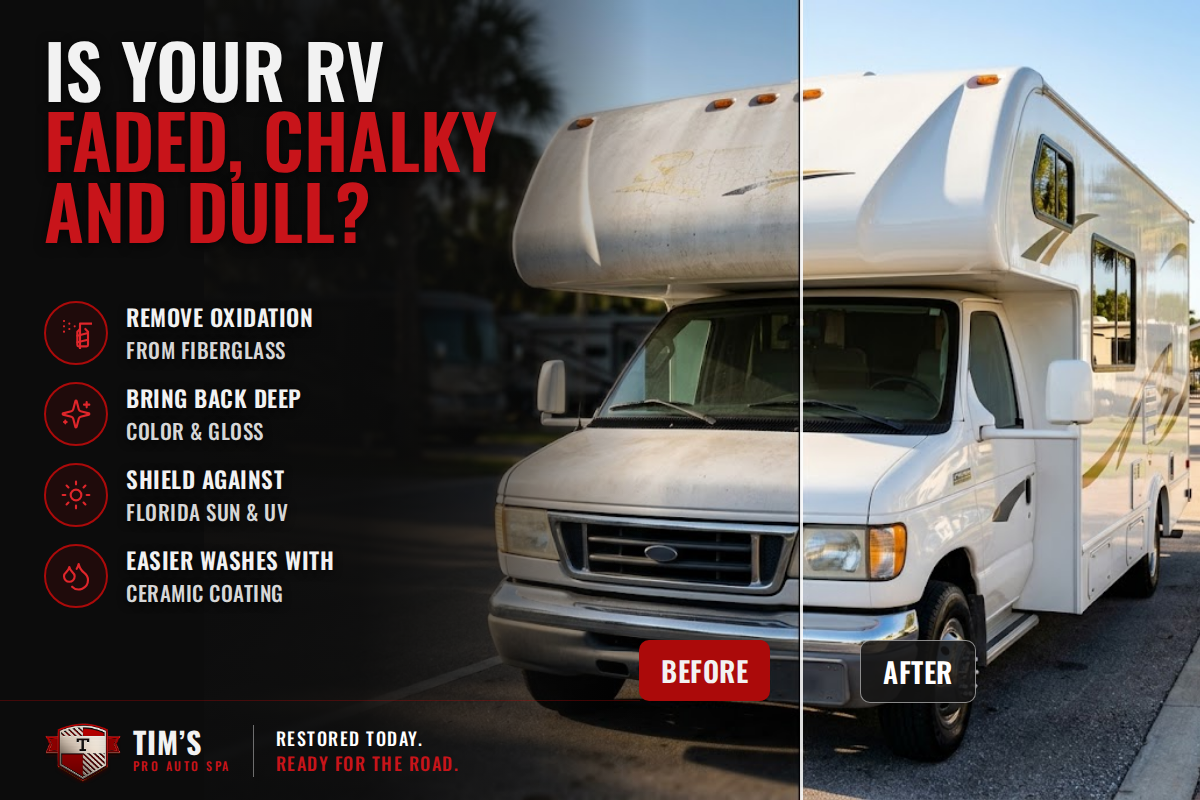
Try this next time you walk past your RV: run a fingertip along the side and look at it. If it comes away with a white or colored powder, your fiberglass is oxidizing. The shiny outer layer is breaking down in the sun, and the dull, faded look you have been noticing is the result.
The good news is that in most cases, oxidized fiberglass can be brought back to a deep, glossy finish. The key is doing it in the right order and then protecting it, so you are not dealing with the same problem again next summer. With RV season picking up around The Villages in October and November, now is a good time to get it done before you hit the road.
How to tell if your RV is oxidized
You do not need any tools to check. Look for these signs:
- Chalk on your hand or towel. Wipe a clean, dark microfiber towel across the side wall. White or colored residue means oxidation.
- Faded color, especially on the front cap, the roof edges, and whichever side faced the sun while the RV was parked.
- Dirt sticks and water sits flat. Black streaks from the roof are harder to wash off, and water no longer beads.
- A rough, dry feel in bad areas, instead of smooth and slick.
Oxidation comes in stages. Light oxidation looks dull with just a bit of chalk. Moderate oxidation leaves obvious chalk and visibly faded color. Heavy oxidation feels rough, leaves thick chalk on your hand, and the color looks washed out. The further along it is, the more work it takes to restore.
When it is not oxidation: Cracks (especially spider-web cracks), bubbles, wavy or rippled walls, or soft spots when you press on the fiberglass point to water damage or delamination, not sun damage. Polishing will not fix those. Have an RV repair shop look at them first.
Why Florida sun speeds it up
Most RVs are covered in gel coat, a hard, pigmented resin layer on top of the fiberglass. UV light slowly breaks down the resin at the surface, leaving a thin layer of powder behind. That powder is what you feel as chalk.
Central Florida gets strong UV for most of the year, and heat speeds the process up. Add a summer spent in an open storage lot, and an RV can go from slightly dull to noticeably faded in a single season. Humidity does not help either: mildew and roof runoff streaks settle into the rough, oxidized surface and become harder to wash off.
Gel coat or paint? Know what you have
Before anyone touches your RV with a polisher, it is worth knowing what the outside is actually made of, because each surface is treated differently.
- Fiberglass with gel coat. Common on travel trailers, fifth wheels, and many Class C motorhomes. This is where classic chalky oxidation happens.
- Full-body paint with clear coat. Common on many Class A motorhomes. When this fades, it is the clear coat breaking down, and it is corrected more like car paint. Methods that work on gel coat can be too aggressive here.
- Rubber roofs (EPDM or TPO). These are never compounded or polished. They are cleaned and treated with products made for rubber roofing.
- Vinyl graphics and decals. Compounding can damage them, so they are worked around carefully. Graphics that are already faded or cracked usually need replacing rather than polishing.
How oxidation removal works
Every RV is different, but a proper restoration follows the same basic steps:
- Wash and decontaminate. A deep wash removes dirt, black streaks, bug residue, and anything else sitting on the surface, so it does not get ground into the finish during polishing.
- Inspect and test a spot. A small area is tested to find the least aggressive method that gets the job done. Gel coat is thicker than car clear coat, but it is not unlimited, and every pass removes a little.
- Wet sand, only if needed. Heavily oxidized areas sometimes need careful wet sanding to take off the dead layer. Light and moderate oxidation usually skip this step.
- Compound. A machine compound removes the remaining oxidation and brings the color back.
- Polish. A finer polish refines the surface and brings back the depth and gloss.
- Protect. This last step decides how long everything above actually lasts.
How long it takes: for a 30 to 40-foot RV with moderate oxidation, plan on about 2 to 4 days. Smaller trailers with light oxidation can be done in 1 to 2 days, while large motorhomes with heavy oxidation can take up to a week.
*Estimate only. Actual pricing and timing may change based on your vehicle’s size, condition, and the options you choose. Contact us at (352) 277-4721 for details.
From our shop: The most common mistake we see is an owner trying to fix chalky fiberglass with a household cleaner, a scrub pad, or a coat of wax. Abrasive pads leave scratches that are harder to correct than the oxidation itself, and wax just sits on top of the chalk until it washes away. If the chalk comes back on your towel after a few weeks, the oxidation was never removed.
Wax, sealant, or ceramic coating?
Once the gel coat is restored, it needs a protective layer on top. Without one, the sun starts breaking it down again right away. Here is how the main options compare:
| Protection | How long it lasts in Florida sun | Good to know |
|---|---|---|
| Wax | A few weeks to a couple of months | Cheap, but reapplying it on a 35-foot RV is a big job. |
| Polymer sealant | Several months | A step up from wax, still needs regular reapplying. |
| Ceramic coating | Typically 2–5 years*, depending on the product and upkeep | The longest-lasting option, and the easiest to keep clean. |
*Estimate only. Actual pricing and timing may change based on your vehicle’s size, condition, and the options you choose. Contact us at (352) 277-4721 for details.
On an RV, a ceramic coating pays off in a few ways. It adds a layer of UV protection that slows down the next round of oxidation. Black streaks, bugs, and road grime release more easily, so washes are faster. And on a vehicle this size, not having to wax every couple of months saves a lot of time or money.
One important point: a ceramic coating locks in whatever is underneath it. Coat oxidized gel coat and you have sealed in a dull, chalky finish. That is why oxidation removal always comes first.
What does it cost?
RV restoration is usually priced by length, then adjusted for how heavy the oxidation is and what protection you choose. A 25-foot trailer with light dullness and a 40-foot motorhome with heavy chalking are very different jobs. For a general look at what drives RV pricing, see our guide to RV detailing cost.
Estimated pricing at Tim’s Pro Auto Spa:
| Service | Estimated price per foot* | Example: 35-foot RV* |
|---|---|---|
| Light oxidation (compound and polish) | $15 – $25 | $525 – $875 |
| Moderate oxidation | $25 – $40 | $875 – $1,400 |
| Heavy oxidation (includes wet sanding) | $40 – $60+ | $1,400 – $2,100+ |
| Ceramic coating (after correction) | $30 – $60 | $1,050 – $2,100 |
*Estimate only. Actual pricing and timing may change based on your vehicle’s size, condition, and the options you choose. Contact us at (352) 277-4721 for details.
It is also worth thinking about the cost of waiting. Light oxidation takes less work to correct than heavy oxidation. Leave it long enough, and the gel coat can wear too thin to polish, which turns a detailing job into a much more expensive refinishing job. Financing is available through our financing options.
Keeping oxidation from coming back
- Wash every few weeks with a pH-neutral soap (use a coating-safe soap if the RV is ceramic coated).
- Rinse off roof streaks early, before they bake on in the sun.
- Store it covered if you can. Covered or indoor storage over the summer makes the biggest difference. If you use an RV cover, choose a breathable one that fits snugly; a loose cover flapping in the wind can scuff the finish.
- Check it once a year, especially the front cap and roof edges, and top up protection before it wears through.
Frequently asked questions
Can RV oxidation be removed for good?
It can be removed and the finish restored, but gel coat will keep aging in the sun. Protection like a ceramic coating slows that down a lot; without any protection, oxidation comes back.
Can I just wax over the oxidation?
Wax can make light dullness look better for a short time, but it does not remove the oxidized layer. Once the wax wears off, the chalky finish is still there.
Is ceramic coating worth it on an RV?
If your RV spends much of the year outdoors in Florida, it usually is. The UV protection and easier washing matter more on a large vehicle, where every wax job takes hours.
How long does RV oxidation removal take?
For a 30 to 40-foot RV with moderate oxidation, about 2 to 4 days. A small trailer with light oxidation may take 1 to 2 days, and a large motorhome with heavy oxidation can take up to a week.
*Estimate only. Actual pricing and timing may change based on your vehicle’s size, condition, and the options you choose. Contact us at (352) 277-4721 for details.
Get your RV ready for the season
If your RV is looking faded after a Florida summer, bring it by and we will check the condition, explain what it needs, and give you a clear quote. See our RV detailing services for everything we do for motorhomes, fifth wheels, and travel trailers.
Get a quote: call (+1) 352 277 4721 or visit Tim’s Pro Auto Spa at 2840 County Road 523, Unit C10, Wildwood, FL 34785. Open Monday to Saturday, 10 AM to 6 PM.